
Oh, Robert
the things people forget about the piano quintet

The Schumann Piano Quintet launches us into a curious musical ecosystem, a world—at least for a while—where every downbeat is expected and every second beat is a surprise.
We begin with the chord the publisher puts on the title page. Immediately we leap up a passionate seventh.
The next bar resolves the seventh and then contradicts its resolution, leaping and falling at once, soaring up to a glorious high note while an inner voice darkens.
And so on.
If you survived this early attack of music theory, maybe you’ll allow this next metaphor. The opening paragraphs of this piece offer a kind of continuous “however,” lurking within music that appears certain. These certainly seem like happy phrases setting forth, bounding along, and it might feel safe to ignore gnawing complexities, to careen ahead.
I was once lectured by a wonderful German cellist (name redacted) on this subject. It happened early in my career, in a cold, stone-floored rehearsal room in Spoleto, Italy, a dark and musty and unpromising room, lifeless like a crypt, but out through a small window high on the wall you could just see that it was another glorious Italian day, a pure orgy of sun, and the window was unspooling a ribbon of light along the wall, a color in which you could almost see the delicious melon or stracciatella gelato you would eat when rehearsal was over, melting in the heat, and dripping on your hand, and you could almost feel how you would lick it off the side of your own skin like a certain character with a peach in Call Me By Your Name, back when we thought he was worth paying attention to.
The cellist thumped his endpin on the stone and said I was paying too much attention to Schumann’s unease and freedom and that the best way to unlock him was to be more literal, more classical, to let the music be. I always thought there was some wise truth to this critique, and some profound bullshit. He demonstrated a bit of what he wanted and I thought—no, man, that’s Brahms, not Schumann. The playing was cold like the room but Schumann is rarely cold. To me, the most eloquent Schumann performances are somehow “about” this tension between his love for certain classical ideals and his even more desperate love for freedom, and there are a million ways to do this. It is bad, of course, to surge and lurch until the audience is seasick. But you cannot pretend the rhythms are just the rhythms. The notes pull at the rhythms, at the phrases. A good Schumann performance—aside from being loving, generous, imaginative, lyrical beyond belief, vulnerable—makes you aware of the fundamental problem, somehow, the problem of this terrible and wonderful uncontainable Romantic feeling being held within phrases…
Schumann bursts at the seams, certainly more than Mendelssohn, more than even Chopin. Chopin conceals his seams; Mendelssohn is content with them, he breathes with them. But Robert!—so much distance between the notes as written on the page and the feeling they are aiming to convey.
—
After the first pair of announcing phrases, famously, the piano takes the wheel to restate the opening idea in a more poetic vein:
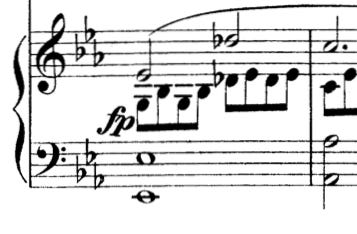
In most performances, people seem to agree: it is now a “piano theme.” But this is a mistake—the piano is only the instigator. It plays the opening leap, sure, an eloquent pair of notes. But the cello responds, marvelously down in the deeps, with its own pair:
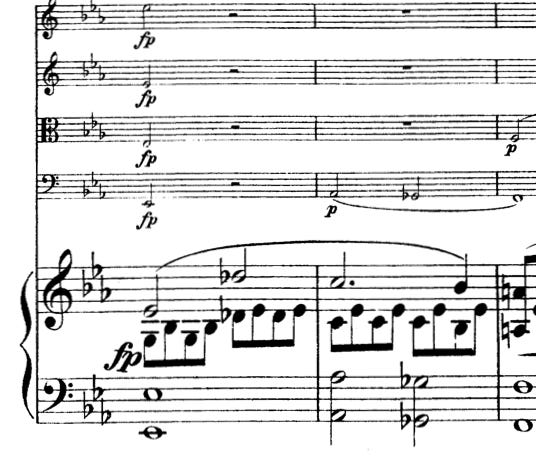
In turn all the other players contribute—rising sevenths, falling seconds, inversions of each other. Imagine a restaurant where the chef offered a dish entitled Seventh, Two Ways. The seventh rises passionately, if you will, to meet the world. The second reflects, darkens, thinks, falls away. (But again these two intervals are in a music theory sense the same, powerful mirrors of each other). Schumann rarely found such a perfect and tidy and effortless way to symbolize and distill his Florestan and Eusebius, his introvert and extrovert, his two facing selves, the one ready with wonder and passion to embrace humanity, the other shrinking away.
These paired pairs of notes create a kind of running engine behind the unfolding of events. A continuous unsettling, also a symmetry.
—
I have the pleasure this weekend of playing this old chestnut of a piece with the young-ish and fabulous Isidore Quartet—and unloading my decades of baggage on them. I suppose the nicer way to say it is to share with them some of my experience?
It is always striking in this piece, how architectural it is. The first movement grandly builds an arch over emotional opposites:
Joy —- Terror — Joy
If you feel that the first part is just too ebullient, too life-loving, almost monotonously happy—well, the development section comes along to solve that problem. He extracts the joyous quarter notes from the opening theme and it’s not quite right to say he develops them. It is more fixation, monomania, desperation. Once started, the pianist refuses to play anything else—until at last we return, when the nightmare sped-up version of the theme crashes back into the joyous version. It is also, amazingly, one giant syncopation, a lack of rhythmic unity that goes on for pages and pages. Everything in the exposition felt like an affirmation of sorts, and now, the stubborn negation, the refusal to be with, to follow along.
The second movement presents (movingly, wisely) an opposed arch of opposites
Tragedy — Redemption — Tragedy
It is wonderful here how the funeral march is so etched, so clear (he says marcato) and the heavenly passages blurred, all written in a syncopated haze with major and minor and triplets and duples and little acoustical effects built into the theme—fragments of not quite hymn that break off from the main stream and sing out a second time.
The Scherzo is also structurally symmetrical—maybe almost too symmetrical?—full of good humor, one sublime interlude, one rough and ready.
The last movement is a non-arch.
It begins by erupting, to reveal just a humble dance-tune, not in the right key (!), jerkily alternating between blocky chords—a melody that is not exactly catchy, and moreover circles back on itself. It starts on G and returns to G. It seems to have nowhere to go. A good, heavy, meat and potatoes German dance without seemingly much potential. But other, lighter dances come along; a more legato theme emerges from that and spins out at ever-increasing length, and if you forced me at gunpoint to explain what I love about this movement it is that the blocky, square ideas, with all their good-humored German stomping and marching, gradually surrender to incredible passages of release, sites where the beats vanish and anything might happen.
One of the best releases comes in the development, out of nowhere, out of a typically odd Schumann impasse, out of a stopped moment of time:
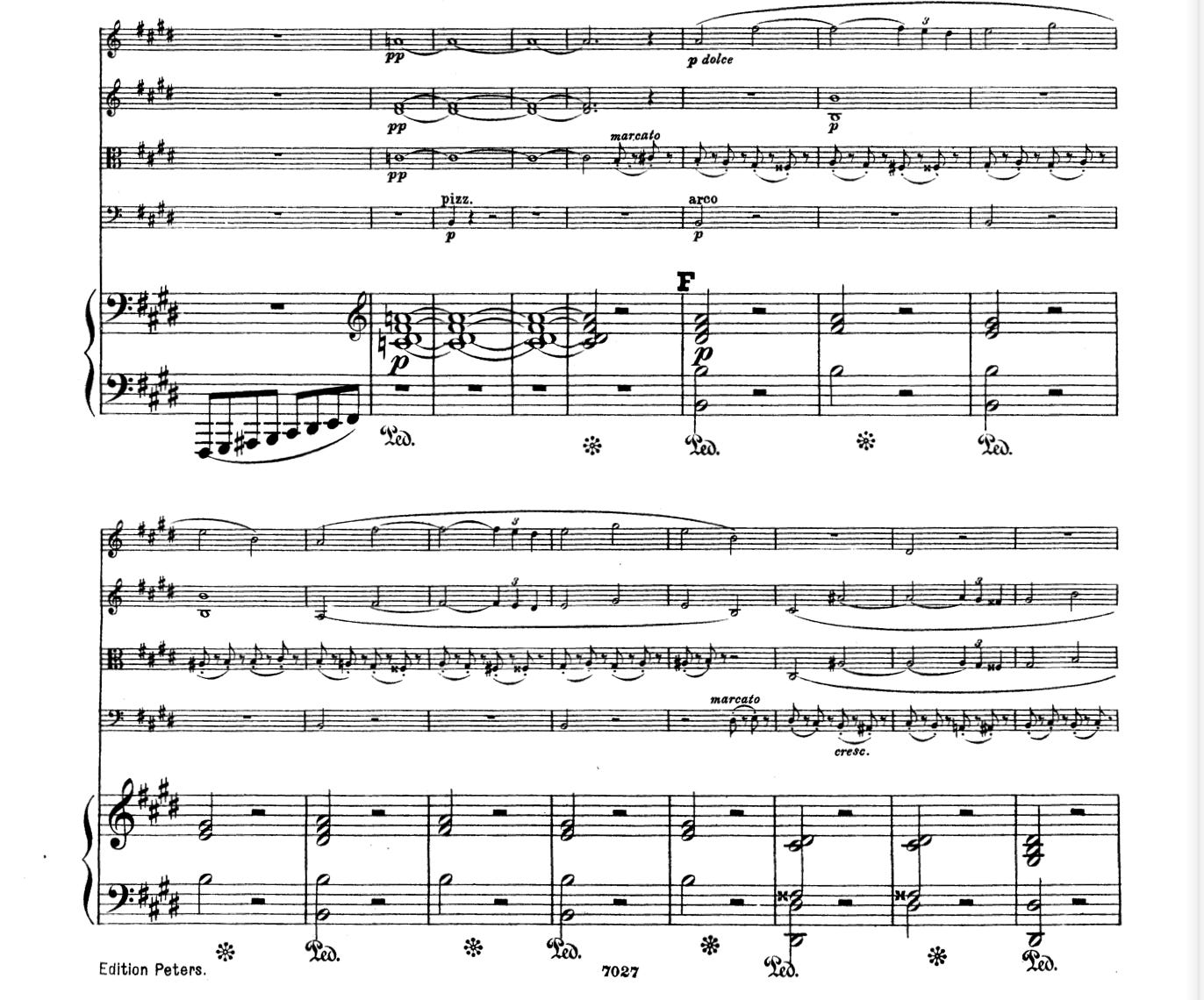
… a sway built on the simplest harmonies, nonetheless so sensual and delightful. This idea comes again at the end, of course, as part of an unfolding series, as one form of joy piles on another.
—
With coffee, preparing to practice the piece again, I went to a well-regarded classical website, just to see what sort of things people write about it. I found the following passage:
The opening “Allegro brillante” commences with a bold and sparkling musical idea that gradually unfolds and expands. Almost immediately, however, a soft and tender dialogue between the viola and the cello contrasts it. In due course, both themes are extensively fragmented and subjected to far-reaching modulations. The second movement “In modo d’una marcia” exudes the ambiance of a funeral march. A dark and mysterious melody is introduced by the first violin and haltingly accompanied by sobbing musical rhythms. The contrasting musical idea presents a welcome relief from this morose atmosphere, yet the movement is once more rounded off by the return of the ungodly march …
What the hell, I thought to myself—even they were using AI to write content! For instance, the spree of ands, “bold and sparkling,” “unfolds and expands, “soft and tender.” Quintessential AI lack of judgement. “Bold and sparkling” reminded me of mineral water, “soft and tender” reminded me of a cut of meat, “unfolds and expands” reminded me of … well, never mind.
If the theme “unfolds gradually” then how the heck does the second theme appear “almost immediately”?
With my last dregs of coffee, I became flush with a Schumann restlessness, a desperate desire to do everything and no focus for anything. Instead of using this energy to love life, I kept hate-reading these algorithmic program notes, loving to hate our new LLM overlords. Does a funeral march really have an “ambiance”? Would you say to a friend (for instance) that their loved ones’ memorial service “exuded” anything?
My partner quietly came and removed last night’s dinner plates, ever so slightly trying to avoid my gaze. The phrase …
the contrasting material presents a welcome relief from this morose atmosphere
… sent me into a new fury, not just its taste of redundancy, but the impotence of the expression to capture the incredible qualities of this musical passage. “Welcome relief” sounded like you burped out some stubborn gas. No: it was ad copy. A perfect storm of get off my lawn started up—God I hated the never-ending commercialization of the world and meaning and the internet …
But then—of course—I looked at the date of the piece: 2014. Oh God. Not AI, not even close. I’d been angry and depressed, but now I was haunted. First of all mourning that time, not long ago, in my lifetime I think?, when you could confidently say that a piece of writing was by a human. When that was really the only option. Second, maybe darker thought—was AI just finally a reflection and a child of our own laziness, our own unwillingness to try harder to express ourselves?
Terrific writing. Don't quit your day job but do please write another book/collected criticism.
You write so gorgeously about music, as always, and now as I’m working on (ok, procrastinating right this minute) writing program notes, I keep imagining them making you fume with their mediocrity. Dang it.