
In a Fever
the Schumann Piano Quartet miracle

Upon arrival in the paradise of Santa Barbara, I got a hellacious flu and had to cancel my recital. I spent days without free will, crawling in and out of bed like an animal, sweating and shaking and consuming fluids in an red-tile-roof apartment with a panoramic view of mesas sloping down to an unseen ocean. I’d fall asleep in the late afternoon and wake while the dawn was a thick marine layer. For an hour, the view was dark flocks of birds flying against endless gray—a haunting black-and-white film. But gradually, orange and pink sunrises tried to reveal themselves within the mist. This slow battle for color went on and on, as if the idea of California, or at least the history of Hollywood, were trying to write itself in the sky.
My mind kept drifting from self-pitying thoughts to the opening of the Schumann Piano Quartet, clear and luminous…
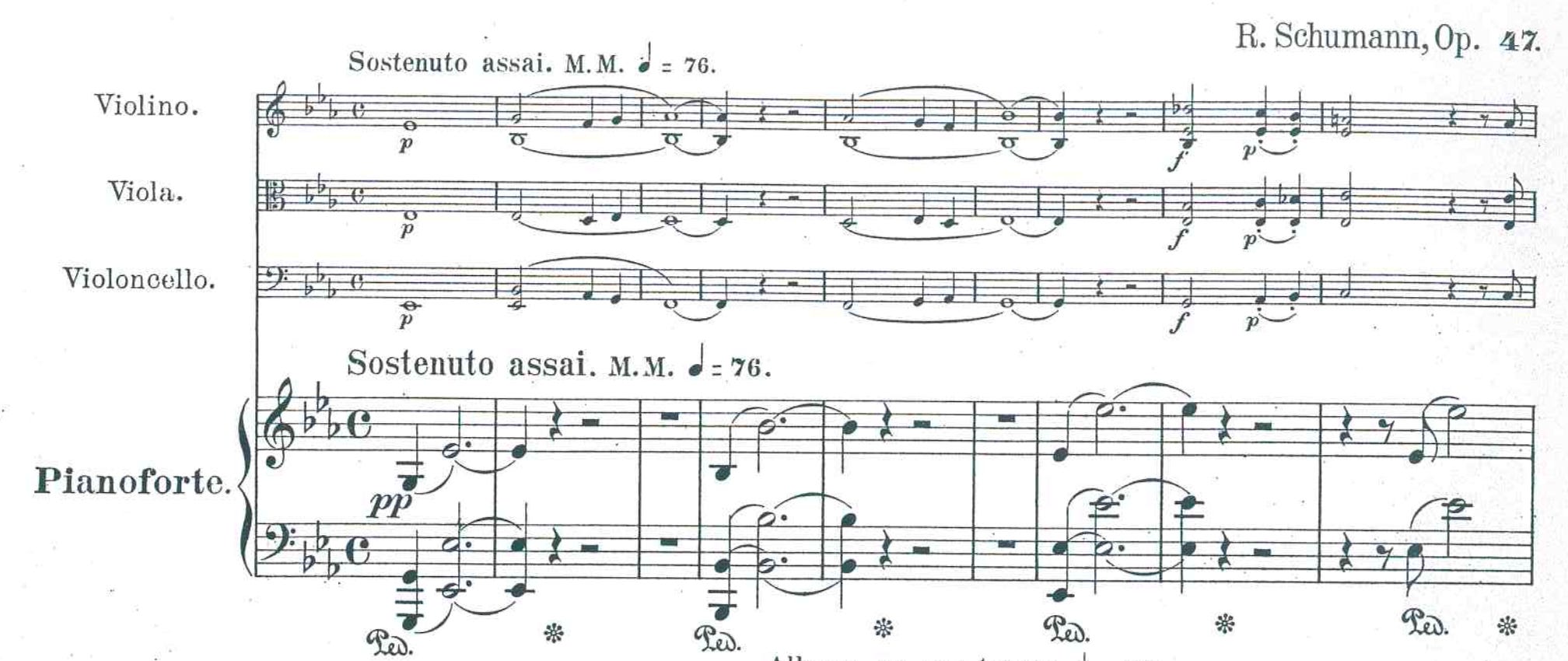
Schumann dares to take on Beethoven, on his home turf: a slow classical introduction, based on the most fundamental harmonies. He even outdoes him (a rare, almost impossible feat). He adopts the back-to-basics trope but adds his unique Romantic magic, laying out the old chords while summoning a new mystery.
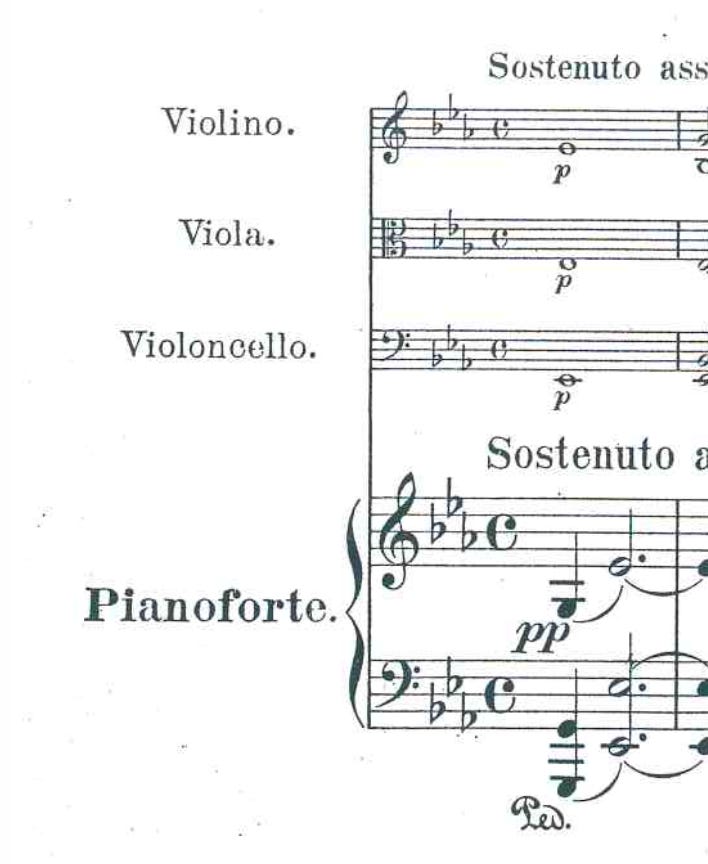
We begin with a string unison. But under this fixed sonority—look—just two notes rising in the piano, with the pedal down. These two notes! They create an unusual, almost inaudible effect: something is moving within the sound of the unison, something is awakening.
Next, the strings play what you might call the Platonic Form of Harmony, a rich chorale moving from one chord to another. Not fancy, Hymn 101, the two most basic chords. And the piano replies with another ascent:
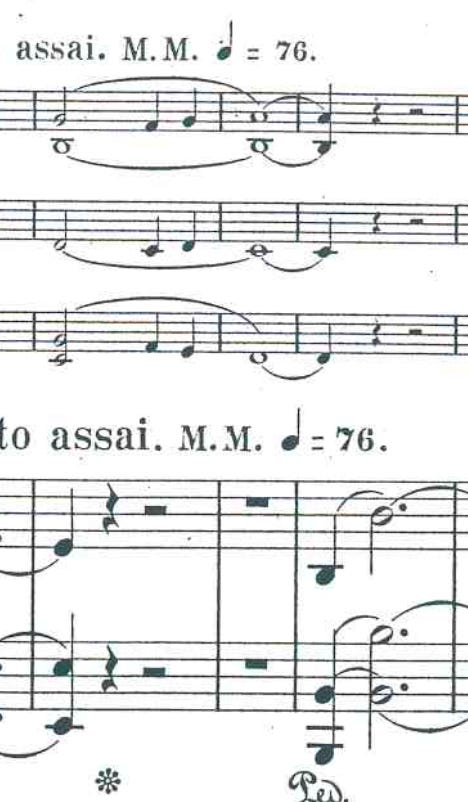
Just an octave, but it says so much (take that, Beethoven!) The strings respond with more wonderful Harmony; the piano rises again. The gist of this conversation becomes clear. Music as we know it, and Harmony, are represented by the strings, gorgeously and roundly voiced in barbershop quartet style, while the open-ended rising of the piano (always with the pedal) creates a kind of halo or overtone around Music. The strings offer the balance of classicism (I goes to V, V goes to I), but the piano keeps romantically rising, asking, unbalancing. The strings keep saying Here It Is, and the piano keeps saying There Is More.
A third statement in the strings—a sudden forte, an outburst of emotion, seems destined to visit the subdominant, the third pillar of Harmony, but
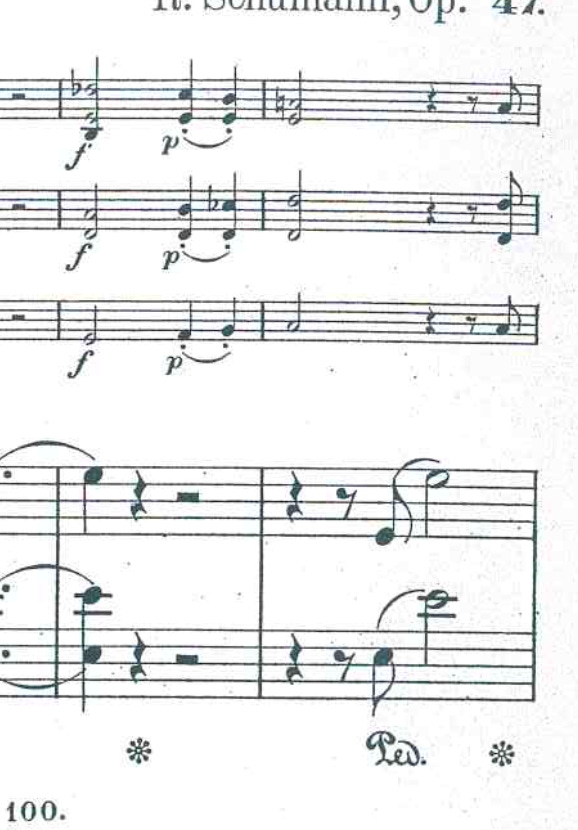
As always with Schumann, the unreachable. The completion of the harmonic love triangle is derailed by a ravishing evasion. The violin falls to an A-natural instead of the A-flat we wanted--our first glimpse of melancholy. It then corrects itself, falling one more half-step to the desired note, but alas, the cello also falls, and so we find ourselves in the minor! In other words, we get lost in a little forest of ambiguity, in various shades of darkness, in chords all around the one we thought we would get.
The piano at last convinces just the violin to join it in rising questions:
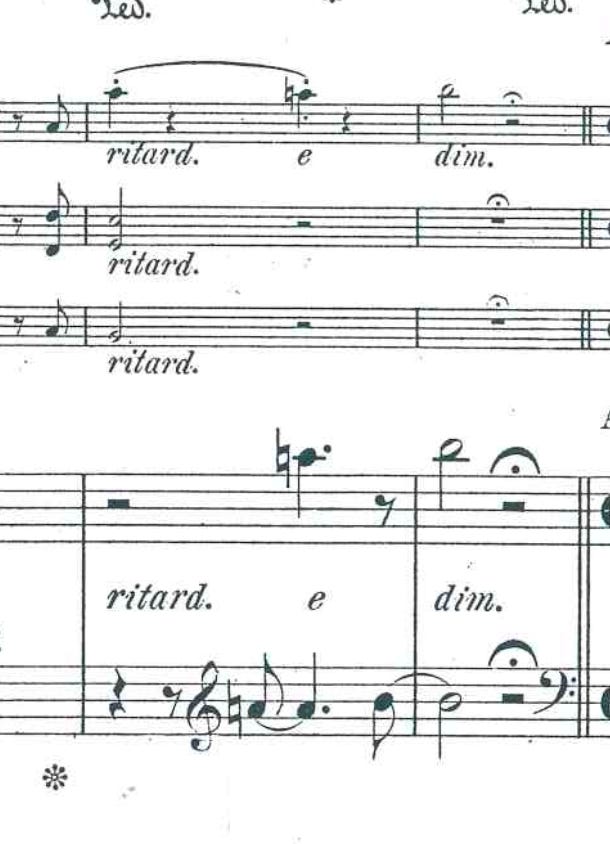
Again, the perfect flu medicine. We abandon downward melancholy, we look up to the sky. And off we go.
—
Forgive the obligatory Odyssey reference, but Schumann had his own compositional Scylla and Charybdis. On the one hand, too much repetition; on the other, too little. He was often in danger of hitting one side or another. Much of his music veers between them, constantly trying to avoid its own pitfalls. In “Pierrot” from Carnaval, he rides repetition as hard as he can, doing the same idea (with its loud-soft gag) an absurd number of times, until it tries to burst out of its cage. He makes this repetition problem work for him, like we all try to make our flaws into assets. In Davidsbündlertänze, conversely, he skates from one mood to the next in a shameless and disorienting and inspired stream-of-consciousness, or attention deficit disorder, placing only one structural repetition in the whole thirty minutes. With the result that we hold this one moment precious; it becomes one of the most heartbreaking musical memories ever written.
This Piano Quartet first movement exploits his weaknesses perfectly. It has, you might say, the best of Schumann’s worst: an abundance of obsessive repetition and also a healthy dose of destabilizing accident. It is not chaos, but it is definitely not order.
The generative seed of this movement is just those four notes of the string chorale, of that first Harmony hymn:
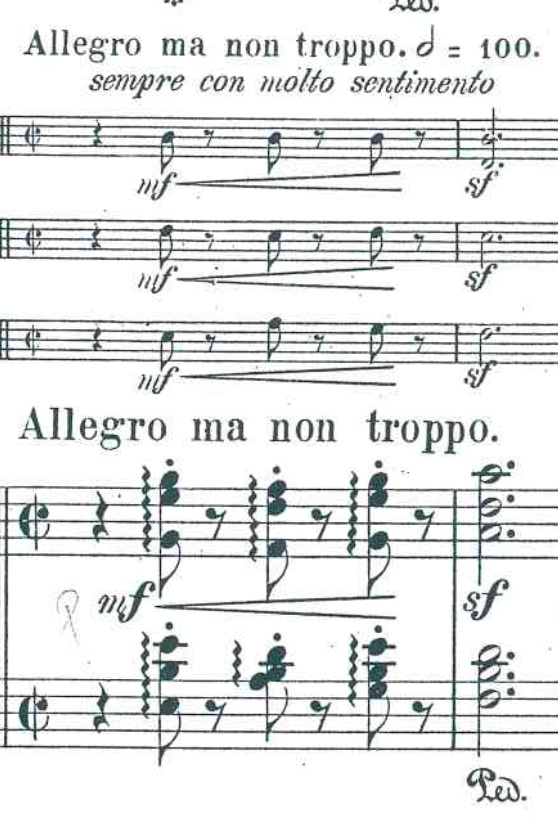
Not really a theme, you might say—more of a question. The piano replies:
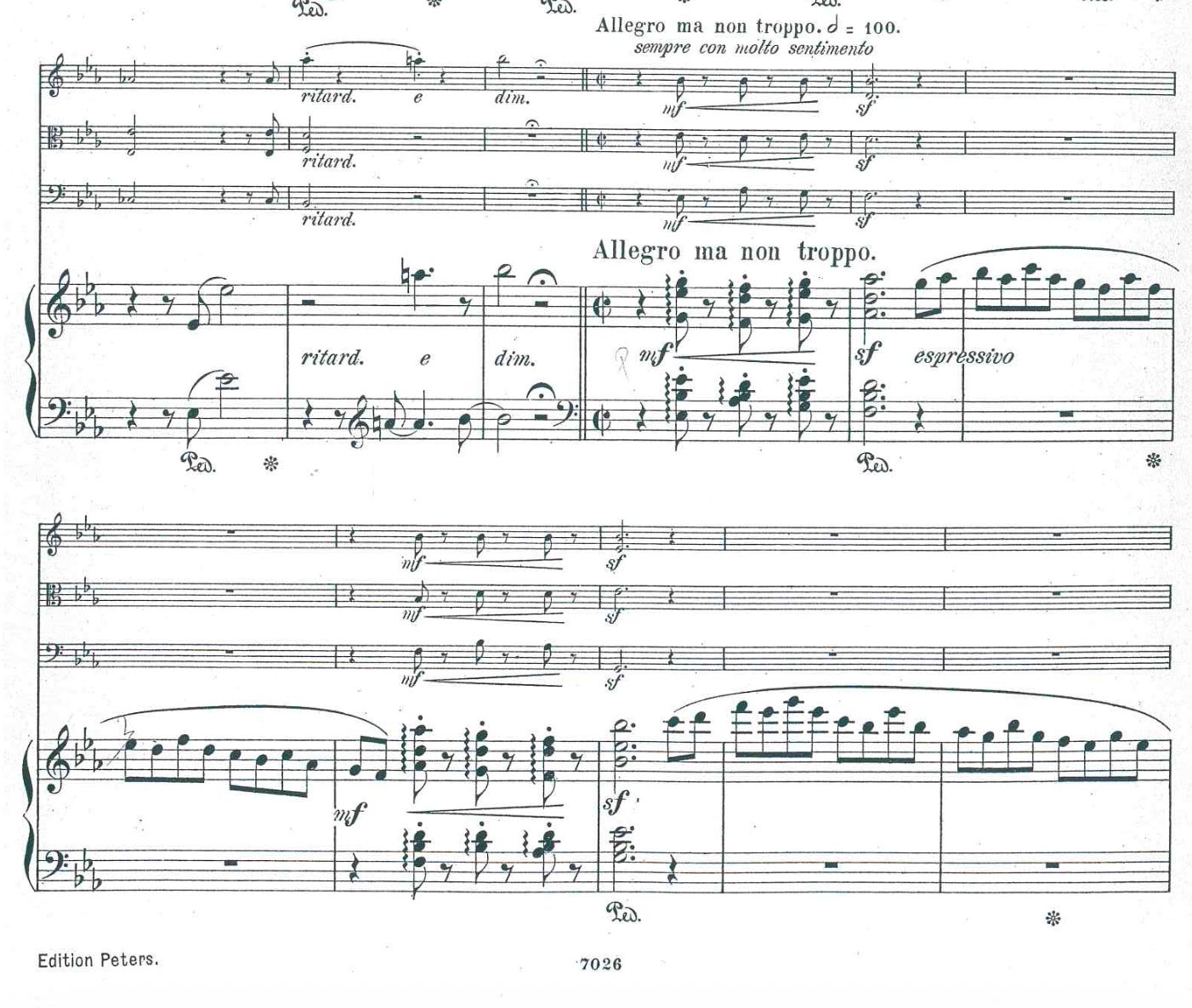
This is the Robert masterstroke, against the grain. The piano reply is a bit of a wet noodle. (Yes, that is the precise musicological term.) A long arpeggio down, with expressive notes thrown in. Mostly a falling pattern, reiterated. It goes on slightly longer than it might. Falling, falling, dissolving the energy and urgency of the question. This weird mismatch is exactly the sort of tension Schumann thrives on. The thrusting four notes of Florestan meet the dreamy semi-stasis of Eusebius.
For a while—four obsessive iterations!—we explore this creative tension, and I’d say it builds with some exasperation, the quick forwardness of the four notes versus the dreamier, longer, almost directionless replies. At last, the strings create a more “normal” reply:
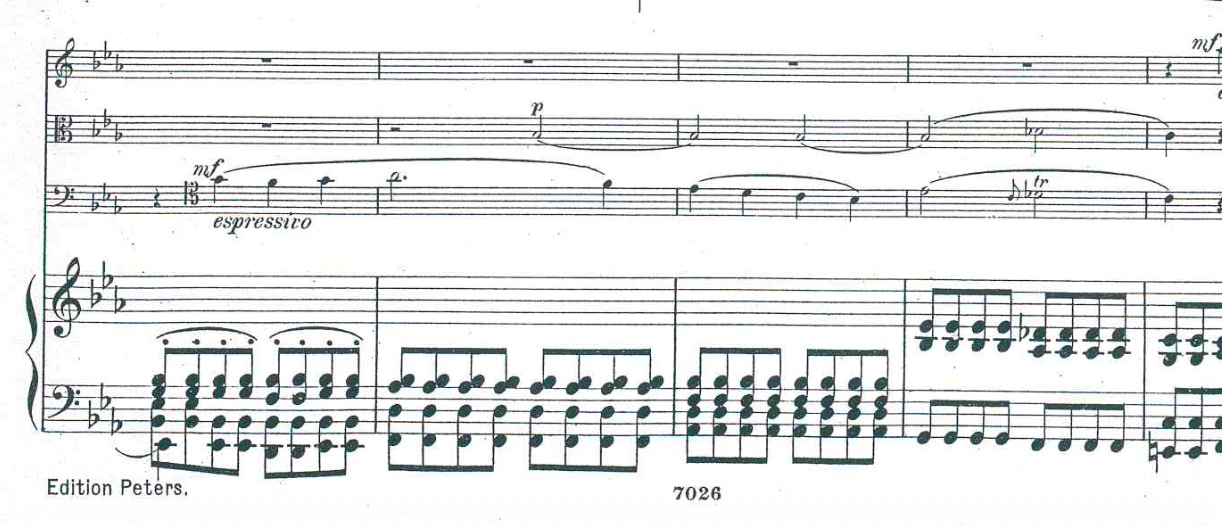
This is how the theme should continue, really, but, just then, we slip into a different idea. A recurring pattern of this piece—just when we get somewhere, we are teleported elsewhere.
Another example, about twenty seconds later. The strings at last come to a big resolution, which lasts all of a quarter note:
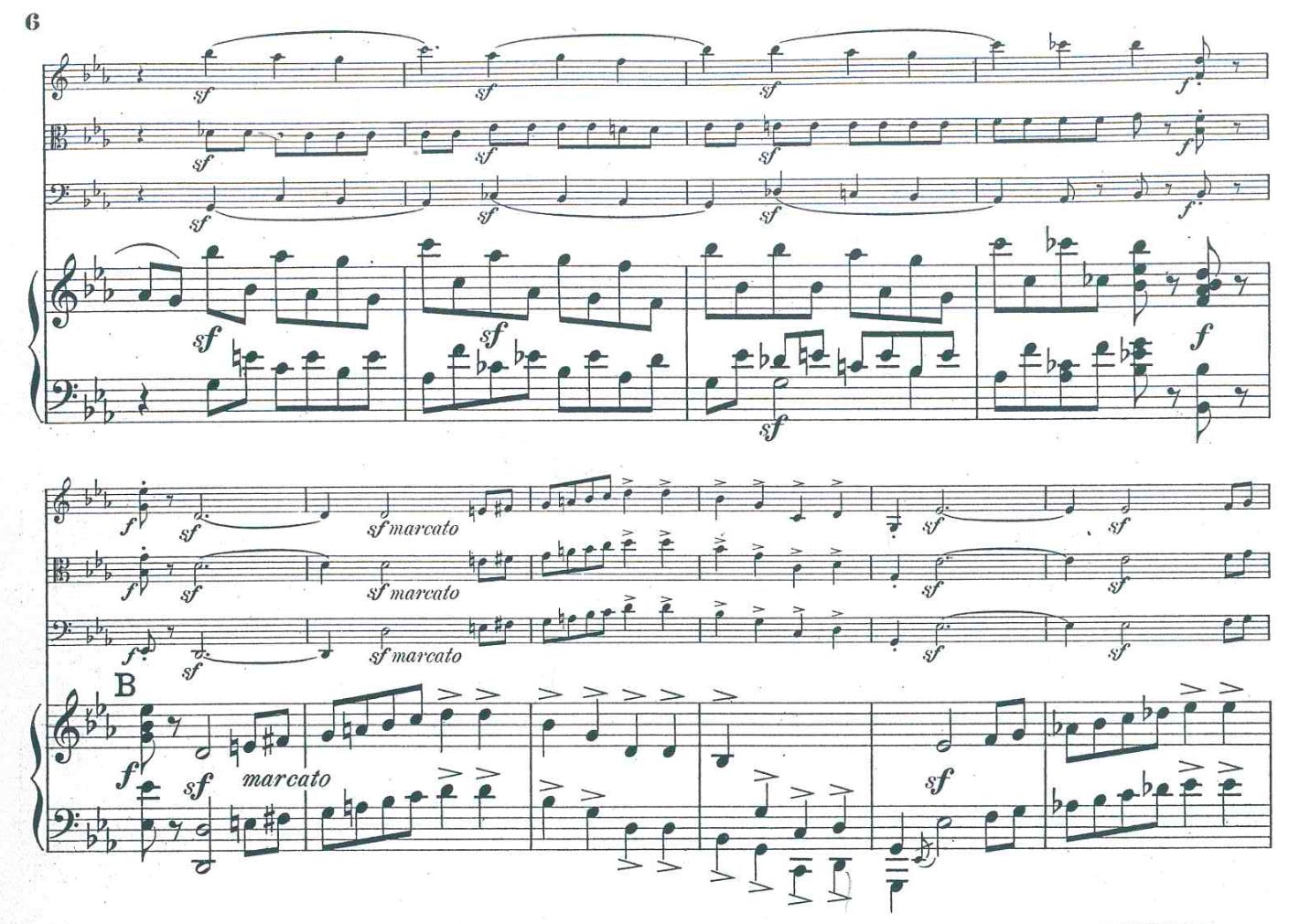
Huge cadence! and yikes, the E-flat slips down to D and suddenly we are in a different key and a different theme—pure chaos, and yet, somehow, it makes perfect sense? The suspension of logic is a huge part of the Schumann agenda. He wanted to create a space like the literature he loved, where the normative and the bizarre sit side by side, equally believable.
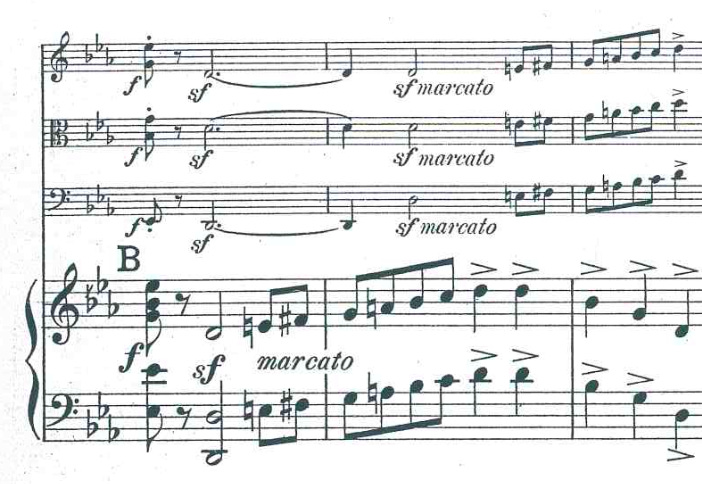
The new theme pinballs around harmonies. It starts on D. Then it lands a tritone away, on A-flat—what the hell ? And what is this theme, anyway? It is a scale up. Full of energy—but finally, just a scale. And then comes a bunch of notes trying to define or land an ending, a slew of stamping accents (see them, up there, eight in a row!), but as often with Schumann you feel that all this desire for closure makes you feel even more unsettled. You’re trying to land a craft that cannot be landed.
—
There is a deep correspondence between our main “themes.” Leave aside for the moment the fact that none of them are all that much of a theme. Consider our iconic four notes, pointing up subtly
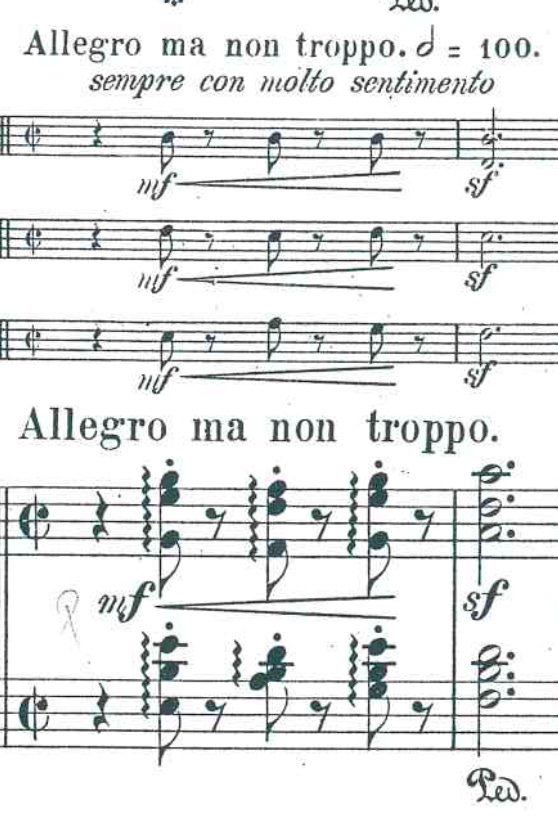
And now our scale, not so subtle, a rocketship up
And don’t forget our mysterious rising notes in the piano in the opening
Three rising ideas, each with their own persona. This is a key to the delicious optimism radiating from this piece, its forward-looking wonderment.
—
I’d say the most impressive accomplishment of this movement is the development, which wanders into darkness to visit the terrors always hiding within Schumann’s joys. Here, interestingly, the music proceeds with Beethovenian logic, through a series of clever sequences, bounding from light to dark, getting submerged in the bass and surging back out. No matter how many times I play this passage, it never seems to lose its particular surprise and power.
Once we get to the climax, though, something happens that is beyond belief. We sit on a dominant pedal in desperate suspense, and the strings suddenly find meaning and terrible tension in tension-dissolving Eusebius. The wet noodle is (you realize) not so wet.
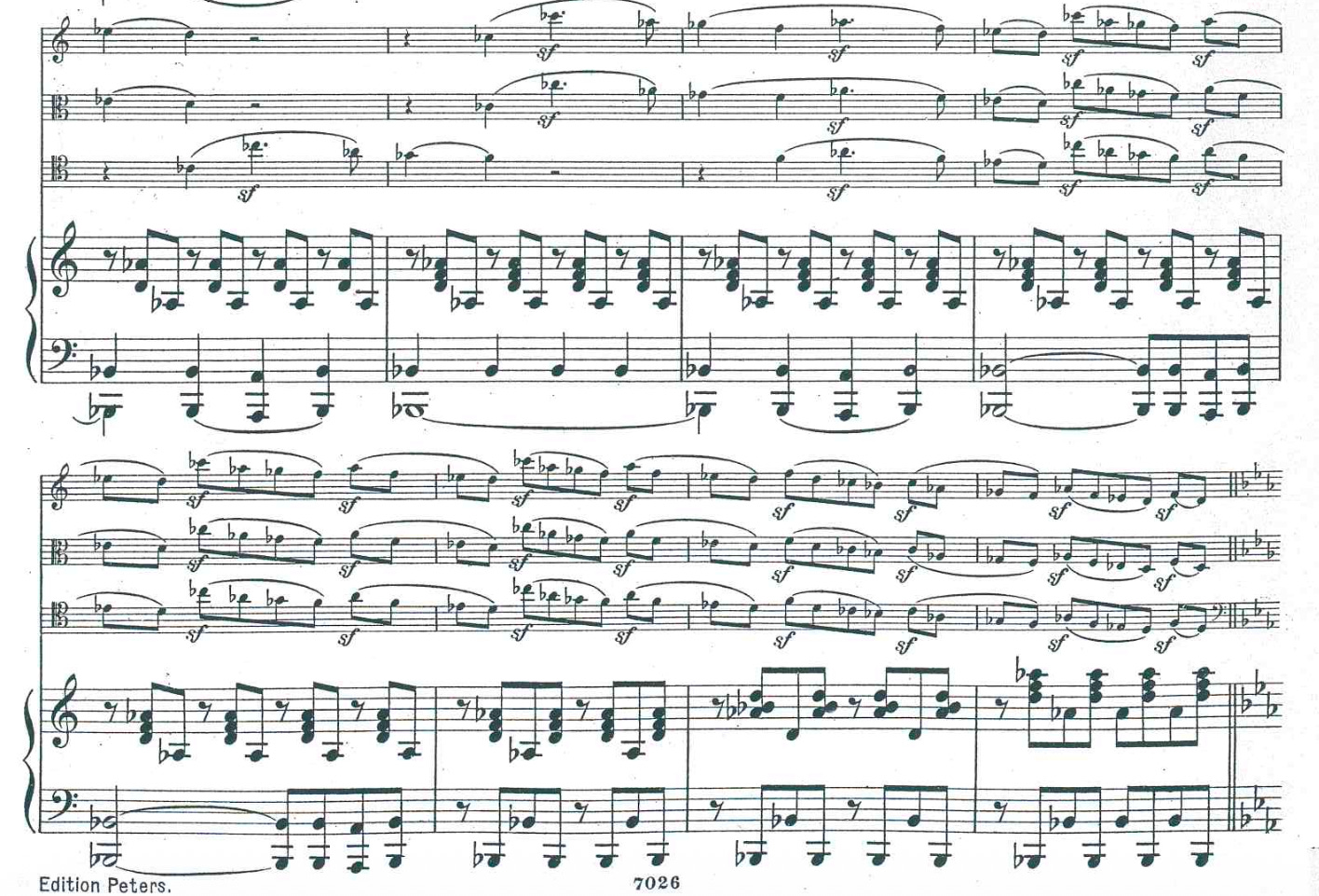
Ah yes, they do have something to say to each other, these two characters, these two ideas!—and just at that moment of revelation, the four notes burst out again in glorious, fevered, ecstatic major:
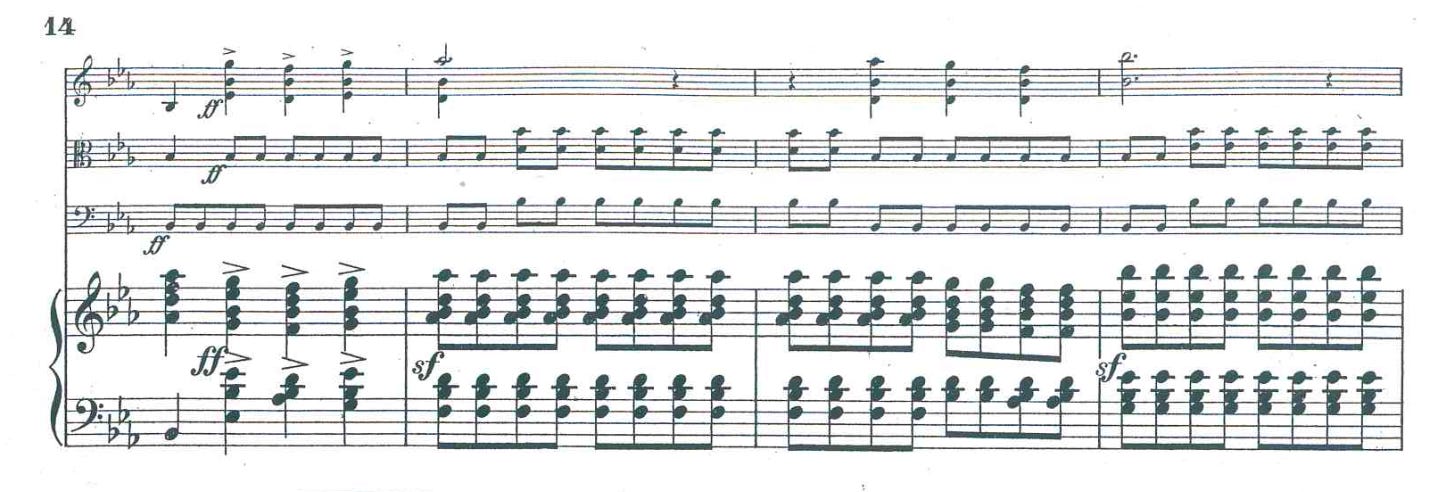
This arrival has no specific note or chord. You don’t arrive “at” this return, you arrive somehow through it, or within it, carried on its wave, which keeps surging past the structure, past the very idea of structure. What a moment. The quivering piano notes, the sense of the chords vibrating. The columns of music are free and alive. At this moment we also hear one of my favorite Schumann discoveries. While many other romantic composers were hunting out rare game, exploring unusual seventh chords or ninth chords, etc. etc., Schumann said “Hold my beer. You guys haven’t even really plumbed the depths of the good old fashioned dominant seventh chord.” And he was right. That familiar chord! It can be so much. Only Schumann (of the Romantics) dug up new expressive worlds in it.
He tells us—there’s life in the old girl yet. Which is exactly how I felt, driving myself back to the Music Academy of the West after the fever passed. My to do list, now that I was reborn? To be a decent mentor, to share what I can. I would be content to take a cue from Robert. It would be a perfect day if I could only explain to an unsuspecting young person the hidden beauty of just one boring chord.
First, I hope you feel better! Love that you're featuring this work. I'm not sure how I had managed to miss it, but the first time I sightread it (viola) this quartet was with a bunch of MIT math professors with whom I had regular gig during law school. We got to the andante cantabile movement and I thought I had died and gone to heaven. I couldn't believe I'd never heard it, let alone played it. I still think that movement is music of the spheres. If that's trite so be it.
As a music theory ignoramus who adores anything Schumann, damn! This was like reading a novel. My heartbeat rose and fell with its twists and turns. And glad you're feeling better. When are you and Steven playing in NYC again?